Ford Mustang 2006 Fuse Replacement
Having an electrical issue? It could be a blown fuse — an easy fix you can do yourself.
Follow the steps below to find and replace the fuse:
Step 1: Find the Fuse Box
In your Ford Mustang 2006, the interior fuse box is typically located under the dashboard on the driver's side. Some vehicles also have an additional fuse box in the engine compartment. Check your owner's manual or the fuse box cover for the exact location.
Step 2: Identify the Corresponding Fuse
Below is the complete fuse list for your vehicle. Find the circuit that isn't working and note the fuse number and amperage.
Passenger compartment Fuse Box
| Fuse # | Function | Amperage |
|---|---|---|
| 1 | Accessory delay #1 | |
| 2 | Not used | |
| 3 | Wiper power | 10 |
| 4 | Power mirrors | 5 |
| 5 | Not used | |
| 6 | Accessory delay feeds | 5 |
| 7 | Overdrive cancel | 5 |
| 8 | Cluster, Data Link Connector (DLC) | 10 |
| 9 | Not used | |
| 10 | Intrusion Sensing Module (ISM), Climate control | 5 |
| 11 | Not used | |
| 12 | Climate control, Ignition | 5 |
| 13 | Not used | |
| 14 | A/C cycle switch | 5 |
| 15 | Brake On/Off (BOO) power | 10 |
| 16 | Cluster | 5 |
| 17 | Restraint Control Module (RCM), Passenger Occupant Detection System (PODS), Passenger Air bag Deactivation Indicator (PADI) | 10 |
| 18 | Anti-lock Brake System (ABS), Positive Crankcase Ventilation (PCV) valve heater, Ignition | 10 |
| 19 | Powertrain Control Module (PCM) relays, Passive Anti-Theft System (PATS) | 5 |
| 20 | Radio (Start) | 10 |
| 21 | Starter relay | 10 |
Power distribution box Fuse Box
| Fuse # | Function | Amperage |
|---|---|---|
| 1 | Not used | |
| 2 | Climate control blower | 30 |
| 3 | Cooling fan | 40 |
| 4 | Starter | 30 |
| 5 | Right front window motor | 30 |
| 6 | Rear amplifier (Shaker 1000 radio) | 30 |
| 7 | Left front window motor | 30 |
| 8 | Anti-lock Brake System (ABS) #1 | 40 |
| 9 | Rear amplifier (Shaker 1000 radio) | 30 |
| 10 | Wipers | 30 |
| 11 | Left rear window motor (Convertible only) | 30 |
| 12 | Right rear window motor (Convertible only) | 30 |
| 13 | Convertible top | 30 |
| 14 | Seat | 30 |
| 15 | Not used | |
| 16 | Front amplifier (Shaker 500 radio) | 30 |
| 20 | PCM #2 | |
| 21 | Fuel pump | |
| 22 | Starter | |
| 23 | PCM #1 | |
| 24 | A/C clutch | |
| 25 | Cooling fan (High-speed) | |
| 26 | Horn | |
| 27 | High beams | |
| 28 | Cooling fan (Low-speed) | |
| 29 | Rear defroster | |
| 30 | Fog lamps | |
| 31 | Convertible top (Up) | |
| 32 | Climate control blower | |
| 33 | Convertible top (Down) | |
| 34 | Not used | |
| 35 | Not used | |
| 36 | Not used | |
| 37 | Not used | |
| 38 | Not used | |
| 39 | Not used | |
| 40 | Engine #2 | 15 |
| 41 | Fuel pump | 15 |
| 42 | Engine #3 | 15 |
| 43 | Alternator | 10 |
| 44 | Delayed accessory | 10 |
| 45 | PCM | 10 |
| 46 | Horn | 25 |
| 47 | Engine #1 | 15 |
| 48 | A/C clutch | |
| 49 | A/C clutch | 15 |
| 50 | High beams | 15 |
| 51 | Convertible top | 10 |
| 52 | Rear defroster | 30 |
| 53 | PCM | |
| 54 | PCM delay | 10 |
| 55 | Not used | |
| 56 | Radio | 20 |
| 57 | Decklid release | 20 |
| 58 | Fog lamps | 15 |
| 59 | SJB #5 (Instrument panel fuse box) | 30 |
| 60 | Not used | |
| 61 | Power point #1 (Instrument panel) | 20 |
| 62 | SJB #7 (Instrument panel fuse box) | 20 |
| 63 | SJB #6 (Instrument panel fuse box) | 30 |
| 64 | Power point #2 (Console) | 20 |
| 65 | ABS #2 | 30 |
| 66 | Not used | |
| 67 | SJB #4 (Instrument panel fuse box) | 30 |
| 68 | Ignition | 20 |
Step 3: Check the Fuse
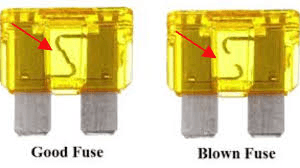
Use the plastic fuse puller, typically found in the fuse box, to remove the fuse. Hold it up to a light source. If the metal filament inside is broken or charred, the fuse is bad and needs to be replaced.
Step 4: How to Get a Replacement
You can buy a replacement fuse at any auto parts store. Make sure you match the **amperage (A)** and **physical size** of the fuse exactly. For example, if you need a 20A fuse, get a 20A fuse.
Step 5: Replace the Fuse
Gently press the new fuse into the empty slot. You should feel a slight click when it's securely in place. Test the affected circuit to confirm it's working again.
What Now?
Fuse Was Blown — What to Buy
Ask at any auto parts store (AutoZone, O'Reilly, Advance Auto) for a blade fuse with the same amperage printed on the old one (e.g., 10A, 15A, 20A). Also match the physical size — mini (most modern cars), standard, or maxi. Replacement fuses cost under $5 and most stores sell assorted packs.
Fuse Looks Fine — Other Causes
If the fuse is intact, the problem isn't a blown fuse. Common alternatives include a bad relay (a click-sized electrical switch), a faulty wiring connection, or a failed component (motor, switch, module). At this point, a mechanic's diagnostic is the most reliable next step.
Frequently Asked Questions
What happens if I put in the wrong amperage fuse?
Higher amperage fuses won't protect the circuit and can cause wiring damage or fire. Lower amperage fuses will blow again immediately. Always match the exact amperage.
Why does my fuse keep blowing?
A repeatedly blown fuse indicates an underlying short circuit or overload. Replacing it again won't fix the root cause — consult a mechanic.
Do I need any tools?
Most cars come with a plastic fuse puller in the fuse box lid. If not, fine-tip needle-nose pliers work. A small flashlight helps.
How do I know what size fuse to buy?
Match the amperage printed on the old fuse (e.g., 10A, 15A, 20A) and the physical blade size (mini, standard, maxi). Auto parts stores carry assorted packs.